

.avif)
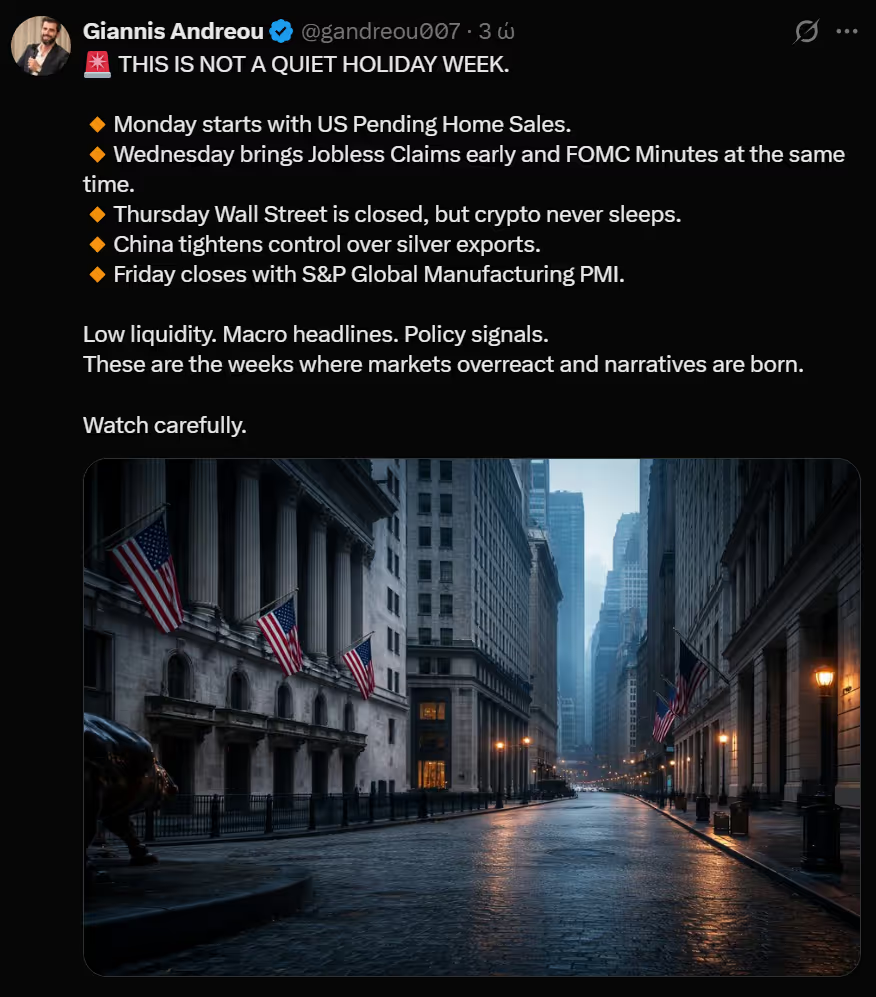
The final week of 2025 delivers exactly the combination that historically produces outsized moves: low liquidity meeting macro-heavy calendar meeting closed traditional markets while crypto trades uninterrupted. The assumption that holiday weeks pass quietly ignores how markets actually behave when participation drops and event risk concentrates.
Low liquidity does not reduce volatility. It amplifies it.
This week combines five macro releases—Pending Home Sales (Monday), FOMC minutes (Tuesday), Initial Jobless Claims (Wednesday), China's silver export controls implementation (Thursday), and S&P Global Manufacturing PMI (Friday)—into environment where traditional equity markets close Thursday for New Year's Day but crypto operates continuously. This asymmetry creates pressure valve dynamics that Bitcoin experienced during previous holiday dislocations.
Monday: Pending Home Sales Tests Housing Narrative
The National Association of Realtors releases November Pending Home Sales Index at 10:00 AM ET Monday. October's reading showed 1.9% month-over-month increase according to NAR Chief Economist Lawrence Yun, though year-over-year comparisons remained negative at -0.4%.
Pending home sales function as leading indicator for closed transactions, typically converting to existing home sales within 30-60 days. With mortgage rates fluctuating between 6.7%-7.2% through November and December according to Mortgage News Daily data, any deviation from consensus signals either resilient demand despite elevated rates or accelerating slowdown in housing activity.
The data matters because housing connects directly to consumer confidence, wealth effects through home equity, and Federal Reserve policy expectations. Weak pending sales data reinforces slowdown narrative and supports case for continued rate cuts in 2026. Strong data revives "higher for longer" fears that markets remain extremely sensitive to following December's FOMC meeting where committee projected just two rate cuts for 2026.
In thin Monday trading, housing market analysts suggest pending sales often provide first signal of broader economic momentum shifts, particularly when financial conditions tighten late in cycle.
Tuesday: FOMC Minutes Drop During Low Participation
The Federal Reserve publishes minutes from December 9-10 FOMC meeting at 2:00 PM ET Tuesday. That meeting delivered 25 basis point cut to 3.50%-3.75% target range while Chairman Powell's statement acknowledged "job gains have slowed this year" and "uncertainty about the economic outlook remains elevated."
Markets will parse minutes for three specific signals. First, internal debate around inflation persistence versus labor market weakness. The December statement noted "inflation has moved up since earlier in the year and remains somewhat elevated," creating tension between dual mandate objectives. Second, discussion around pace and magnitude of 2026 rate cuts. The dot plot projected median of 3.00%-3.25% by end-2026, implying just two additional 25bp cuts. Third, any mention of balance sheet normalization or quantitative tightening trajectory.
According to Fed watchers at Bloomberg and Reuters, minutes released during low-liquidity periods historically amplify bond market moves as algorithmic systems react to keyword analysis while human oversight remains reduced during holiday weeks. This creates mechanical volatility independent of fundamental message.
Wednesday: Jobless Claims Hit Same Day as Holiday Volatility Peaks
Initial Jobless Claims release moves to Wednesday December 31 due to New Year's Day holiday, creating unusual single-day concentration of labor market data and year-end positioning.
The most recent data showed claims falling to 214,000 for week ending December 20, the lowest reading since January 2025 according to Department of Labor figures. That print came with usual holiday-period volatility warnings, as seasonal adjustment factors struggle around Thanksgiving and Christmas weeks. Continuing claims rose to 1.92 million, suggesting labor market maintains "low hiring, low firing" equilibrium rather than showing genuine strength.
The Wednesday timing matters because traditional equity markets remain open but participation collapses ahead of Thursday closure. This creates environment where jobless claims surprise—either direction—propagates through thin order books without normal liquidity buffers. Crypto markets, operating continuously, become primary venue for risk expression when U.S. equity markets close early or trade with reduced depth.
Thursday: China's Silver Controls Take Effect While Wall Street Closes
January 1, 2026 marks implementation of China's new silver export restrictions requiring government licenses and minimum 80-ton annual production capacity for exporters. China controls 60-70% of global refined silver supply according to industry data, making these controls structurally significant regardless of immediate price impact.
The Ministry of Commerce policy effectively sidelines hundreds of smaller exporters who previously supplied global industrial users. Silver serves dual role as industrial input (solar panels, semiconductors, electronics) and monetary metal, creating spillover effects beyond commodity markets into manufacturing costs and inflation expectations.
Silver prices surged from $32/oz in January 2025 to $52/oz by December, a 63% gain according to COMEX futures data, with physical premiums exceeding standard pricing significantly. The export controls formalize what markets already began pricing: structural supply deficit as China prioritizes domestic demand for renewable energy buildout and electronics manufacturing.
The Thursday timing creates asymmetry problem. U.S. equity markets close for New Year's Day. European markets operate half-day or close early. Asian markets remain open but with reduced Western participation. Crypto markets trade 24/7/365 without pause. This fragmentation means any surprises around implementation—either stricter enforcement than expected or temporary waivers—will price first in thinner, more volatile venues before U.S. markets reopen Friday.
Commodity analysts at Bloomberg note silver's classification as strategic mineral by U.S. government in November 2025 elevates these controls beyond normal trade policy into geopolitical resource competition. That framing influences how markets interpret supply restrictions, particularly given ongoing tensions around critical mineral access.
Friday: Manufacturing PMI Closes the Loop
S&P Global releases December Manufacturing PMI at 9:45 AM ET Friday January 2, providing final datapoint of holiday week and first major indicator of 2026 economic trajectory.
November's final reading came in at 49.7, barely below the 50.0 expansion/contraction threshold, after preliminary estimate of 49.2 according to S&P Global. The report showed "output and new orders fell modestly" while "firms remained cautious about hiring" and "business confidence was historically weak."
PMI data strips away narrative and focuses on actual orders, production, and business sentiment at operational level. Markets entering 2026 face binary scenarios: controlled slowdown allowing Fed policy easing without recession, or delayed downturn arriving after financial conditions already loosened. PMI readings consistently below 50.0 force repricing across equities, rates, and risk assets as recession probability increases.
Macro strategists at Morgan Stanley and JP Morgan note PMI releases near contraction territory historically trigger volatility when consensus positioning leans optimistic. Current equity valuations and credit spreads suggest markets price benign outcome despite manufacturing weakness, creating vulnerability to negative surprise.
Why Market Structure Amplifies Holiday Week Risk
The dangerous element isn't any single release. It's the combination of concentrated event risk, reduced liquidity, and fragmented market operations creating mechanical vulnerabilities.
First, algorithmic trading systems dominate holiday period volume. Human discretion drops while automated strategies execute based on headline parsing and technical signals. This creates exaggerated initial moves that may not reflect genuine fundamental reassessment. Second, market maker balance sheet constraints tighten around year-end as firms reduce risk ahead of reporting periods. Bid-ask spreads widen, order book depth decreases, and price impact from given transaction size increases. Third, crypto markets remain open while traditional markets close or operate reduced hours, concentrating global risk sentiment expression into less liquid, more leveraged venues.
For Bitcoin and altcoins, this environment proved problematic historically. When traditional markets step away, price discovery shifts to perpetual futures markets where leverage ratios reach 10-20x and liquidation cascades can trigger without normal institutional participation providing stabilization. The November CPI liquidation cascade showed how $140 million in levered longs unwound in hours when market structure broke, independent of macro fundamentals.
The Counterargument: Markets Already Priced Holiday Risks
The opposing view suggests this analysis overstates holiday week danger by ignoring how markets actually behave.
First, year-end positioning already occurred through December. Institutional investors completed portfolio rebalancing, tax loss harvesting, and risk reduction before Christmas. The final week represents cleanup rather than major directional shifts. Second, data releases carry reduced surprise potential. Consensus forecasts for pending home sales, jobless claims, and PMI all cluster tightly, suggesting economists confident in trajectory. Absent significant deviation, these prints confirm rather than challenge existing views. Third, crypto correlation with traditional risk assets decreased through Q4 2025. Bitcoin's 90-day correlation with S&P 500 dropped to 0.58 from peak of 0.79 in October according to correlation data, suggesting increasing independence from macro liquidity drivers.
The strongest counterpoint emphasizes that holiday week volatility, when it occurs, typically mean-reverts quickly as markets reopen and participation normalizes. Sharp moves during thin trading often represent noise rather than signal, creating opportunity for contrarian positioning rather than risk requiring defensive action.
What This Means for Positioning Through New Year
For spot holders, holiday week volatility represents noise unless sustained through January reopening. Intraday swings during low-liquidity periods rarely carry forward once participation normalizes and institutional capital returns. The relevant question isn't whether Bitcoin moves 5-8% during holiday week but whether any such move reflects changed fundamentals or mechanical market structure.
For derivatives traders, the week presents clear risk-reward asymmetry. Maintaining leveraged positions through period of concentrated event risk and reduced liquidity requires position sizing that accounts for potential liquidation cascades independent of fundamental view. Reducing leverage or avoiding positions entirely during Wednesday-Thursday window when traditional markets close but data continues flowing represents prudent risk management.
The forward signal to monitor is how quickly holiday period moves reverse versus persist. Rapid mean reversion suggests mechanical volatility from market structure. Sustained directional pressure into January 2-6 indicates genuine repricing from fundamentals. Historical pattern suggests distinguishing signal from noise becomes possible only after markets fully reopen and institutional participation returns.
Markets enter 2026 without clarity. Inflation cooled from 2023 peaks but remains above target. Labor market softened but hasn't collapsed. Federal Reserve signals flexibility while maintaining restrictive stance. Investors remain caught between fear of missing recovery and fear of entering just before downturn.
Holiday weeks don't define long-term trends. They reveal where stress concentrates and which participants positioned poorly. According to market historians, the most important information often emerges when participation is lowest and complacency appears highest. When five macro releases, three market closures, and continuous crypto trading collide, volatility becomes statement about structure rather than fundamentals. This is one of those weeks where positioning matters more than prediction.


.png)